Mount Shasta Area | Lassen Area | Trinity Alps | Shasta-Trinity NF | Klamath NF | Redwood Coast | Wine Country | Bay Area | Sierra Nevada | Hiking Advice
I climbed Ostrich Peak on a late January day, a hike with 2400 feet of elevation gain over 3-4 miles. Ostrich Peak is one of the main mountains directly above Ashland in southern Oregon, where I’m currently housesitting for my brother Eric and his wife Nancy.
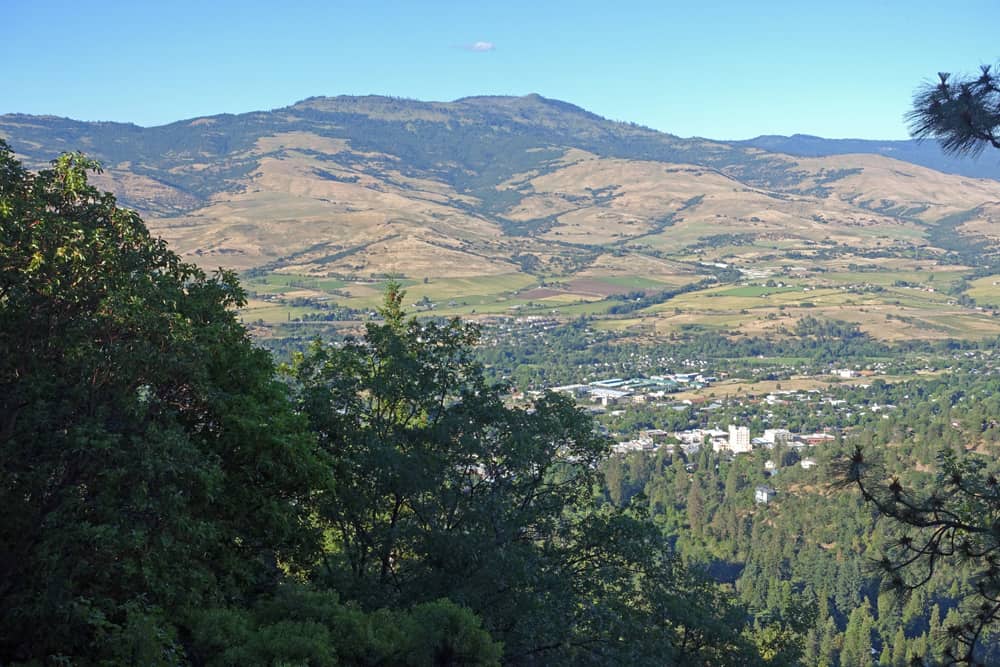
Ostrich Peak and Ashland, Oregon. This pic is from late spring, not winter.
It turns out that Ostrich Peak and nearby areas are on private property. After many years of hassles and problems, the owners have reluctantly decided to block access to Ostrich Peak.
And What Happened on Ostrich Peak?
Well, I got myself into a bit of a situation, and I had a decision to make. And I chose the higher risk option.
Here’s What Happened on Ostrich Peak
I left Eric and Nancy’s house at 3:20 on a sunny afternoon, thinking it was too late to try to get to the top of Ostrich Peak, a hike I’d never done before. Just once I’d hiked a bit of the way, to a point just above a local outcrop called Acid Rocks. I did have rough directions to the summit given to me by my friend Niel.
So as I kept climbing, I started wondering if I could actually make it to the summit and get to see those outstanding views Niel raved about. So I climbed fast and hard, with no breaks.
I was also looking at the time, wondering if I could possibly make it to the top and down before it got too dark.
Pertinent Factors
1. I wasn’t clear on the actual length of the trail to the top, or what the total elevation gain was.
2. I had no water and only 4 Fig Newmans.
3. The weather was clear and calm, with an afternoon high of about 44 in Ashland, but warmer temps at higher elevations due to a temperature inversion. The same pattern was predicted for the next several days.
4. The trail was mostly dirt and just the right consistency for good traction: still moist from past rains, but not slick.
5. My overall physical condition is fairly good right now. I have decent aerobic capacity, and my legs are used to climbing and being worked, in part from hiking and walking, but also from doing a lot of tai chi and related Chinese arts, and spending a bit of time doing strength training.
6. I was wearing pants, a t-shirt, a sweatshirt, and a fleece pullover, and I had a stocking cap for my head. Cotton all the way, baby!
7. I had no cell phone, and it was unlikely anyone would be on the trail that late. If I got injured, or didn’t make it down before dark, I’d have to spend the night out there, wearing just those cotton clothes.
8. I didn’t tell anyone what I was doing.
A Classic Situation…
The higher I climbed, the more I wanted to get to the top. The problem: I wasn’t sure how far it was to the top, and I wasn’t sure if I could get back to paved roads in upper Ashland before it was just too dark to see.
So I set a turnaround time that would allow me to make it down comfortably to town. But I kept pushing that time later and later as I got closer and closer to the summit.
My Decision
I finally set my turnaround time at 5:00 p.m., about 10 minutes before sunset. I felt I could run down the 4-plus miles of trail in twilight and just make it before it got too dark.
Summitting Ostrich Peak
I summitted Ostrich Peak at 5:05. I spent two minutes taking in the brilliant orange glow to the southwest, and also the views of Mount Ashland, Grizzly Peak, Mount McLoughlin, the Crater Lake rim, and other Oregon Cascades peaks as I quickly ate 3 of the 4 fig bars.
Then I began my long descent, running fast with short steps. I soon got into a groove, going just fast enough that I had little chance of falling, and digging the full concentration I had to use to stay upright and avoid the occasional intruding branches. For some reason I had Willie Nelson’s version of “On the Sunny Side of the Street” playing in my head the whole time.
Initially I had enough light, but the last mile or so was a bit tricky, especially in thick trees. I hit pavement at 6:05 p.m. and walked the last mile along quiet backstreets, admiring the sky full of stars above and the lights of lower Ashland below.
I got back to Eric and Nancy’s at 6:30, 3 hours and 20 minutes after I’d left. A hot shower relaxed my body and washed away the sweat. I ate a light dinner and went to bed early. My quads were a bit sore for a couple of days from the fast downhill, but overall I felt great.
My Video from Ostrich Peak
I shot this video of Mount McLoughlin from the summit of Ostrich Peak in late spring of 2014.
Your Take on My Ostrich Peak Climb
I took a calculated risk here, and I’d like to know what you think. Should I have turned around earlier? Did I suffer from peak fever? What would you have done?
Camp for Free in California National Forests
California’s national forests and BLM lands have thousands of miles of dirt roads with lots of spots for dispersed camping (boondocking). My book provides all the info you need to get started (but is not a guide to specific sites):
It depends. If you could have continued and found your way down in the dark, however slowly, ok. If you had to stay over, no. We once got in a similar situation, but had an abandoned dirt road to follow. Used our hiking polls like a blind person’s cane, swinging from side to side to find edge of trail.
Ralph, this isn’t the first time I’ve come back from a hike well after dark, believe me! One time I had to follow a dirt road in the dark in the Escalante area of southern Utah after I got slightly lost and couldn’t find where I’d parked my van. And I had my two golden retrievers, Hana and Molly, with me.
Hi John, Yes,you took risks. You know that or you would not have put out this question. But it is your body and your life. If you want to take a stupid chance that is your option. Only trouble, others will feel it necessary to come to your rescue. Maybe it is their freewill option too, so what the hell. One thing you did not say, but I gather that you did not tell anybody what you were doing. So it goes. Glad nothing bad happened. Like to keep a friend. Bye, Ronald
And…that’s number 8. I did mention to my partner Stephanie that I was planning to do this hike, but we didn’t set up a follow-up call for me to tell her I was back safely.
I definitely didn’t have enough information about this hike — length, elevation gain, or even a map. I thought it was shorter and easier than it actually was.
I agree with Ralph…it was a calculated risk and I would have probably made the same choice as long as the trail back was clear and safe enough to jog back…I bet if you think back and are honest with yourself you knew when you left that you would climb it..so you could have grabbed water and a cell phone in a few minutes time, right ? Live and learn….besides that we all need a bit of adventure now and then…good story
Martin, you’re right. I should have taken my daypack with a cell phone, water, food, emergency space blanket, etc. I didn’t plan well enough. Definitely live and learn.
Knowing the risks is key — this is more risk than I would’ve taken on, most likely, but I’ve done a sunset hike with 2000 feet of descent in the twilight and darkness on a path I knew by heart, which might’ve seemed way too risky to somebody who didn’t know the way.
I think the mind can subconsciously adjust to the risks if you’re aware of them; it’s not knowing the risks that gets so many people into trouble.
John,
You are an experienced hiker so the risk factor is relative. The issues I have with your hike are: 1. Not letting someone know where you are going and when you expect to be back 2. wearing cotton when you should know that you are going to be exerting yourself creating perpiration, damp clothing3. not taking the basis hiking essentials with you, ie..water, basic food, thermal blanket etc. Many of us have been caught in the dark before finishing our hike but the key issue is where are we hiking in the dark and how far from our start point. Good story and a very good reminder to be prepared.
Richard
Richard, you are absolutely right. When I left, I figured I wouldn’t have the time to do hike to the top, so I treated it like a walk in/near civilization that would be over in an hour or so.
In the future I’ll prepare for a wider range of hiking options = take the necessary stuff!
You probably should have done all those safety things mentioned (bring water & real clothes, notify someone, etc.). But in your case it’s no big deal. The key to me is that you were going up and down the same big trail. Whoopty do. I’ve made that same hike. If you were doing a loop or going cross country then that would be a whole new ball game, especially during a new moon! But you didn’t.
You and I have taken dozens (hundreds?) of hikes together and often come back after dark. No big deal. This was a good story. It would have been even better had you run into one of our local mountain lions or bears after dark. Gulp.
Eric, you’re right. It’s much easier to come back down a trail you just went up. And I definitely have memories of walking back in the dark when we were much younger, very good memories actually.
On a 1 to 10 scale of risk, I would rank this at about a 3.5, which in my mind means that the odds of anything bad actually happening to you – even if you had to descend in total darkness – are pretty low. But as we know, disaster can strike when least expected: twisted ankle, snakebite, shin splints, getting lost, etc. To me, your biggest mistake, far and above not letting anyone know what you were up to, was not bringing water for such an exerting outing.
Yes, I should have brought water. There was trailside water in a couple of places that I figured I could drink in an emergency. Plus the temps were low enough that I felt I could go a night without water and still be OK.
Hiking wouldn’t be any fun if you didn’t take a risk now and then. I did the same thing on one of the Three Sisters in Oregon. But being a wuss I turned around before getting the peak and got down before dark.
It is an adventure when we approach our limits and take a bit of risk. I don’t think turning back on Three Sisters makes you a wuss, though. I think it shows you’re smart.
In the paper this morning, 2 women in their 50s, both experienced hikers trekking in a place they knew well, got stuck overnight in northern Oregon because they couldn’t make it back in time and were stopped by a creek. They are none the worse for wear, but a search party was sent out for them and rescued them.
Had they started an hour earlier, they would have not been caught in the dark . Same with you. Had you started at 2pm, you would have made it easily back by dusk. It’s good to allow more time than needed to do a hike. That way, if all goes well, you have extra time to smell the roses.
I typically like to start earlier than I need to (or think I need to) so that I have time for more options or to deal with any unexpected circumstances. I initially was thinking I was just doing more of a walk, with a bit of climbing up the Ostrich Peak trail for exercise, but then I caught a case of peak fever.
Now that everyone has scolded you enough, I was thinking about the jog downhill. I’m envious. A few years ago I did something to my knees, and to this day I get pain from anything downhill, walking or running. It’s very frustrating for a lover of all things hiking while living in a area with plentiful hills.
We’re all prone to taking risks. Just don’t be one of those stories we see on television. I bet they never thought it would be them either.
Sorry about your knees Mike. Have you visited an orthopedist? Sometimes joint pain just needs the right physical therapy. That was the case for a shoulder injury I got from jujitsu several years ago.
One thing I was curious about, John: Was there any possibility of rain, snow, or heavy mist getting you wet? If so, I’d say the biggest mistake was not taking raingear, because you really can’t make heat fast enough to offset wet cotton clothing. Stick someone in rain with a little wind, and there’s a good chance they won’t make it overnight. Even a couple of big garbage bags give you an edge in that situation. Otherwise, I’d say a headlamp and note on the door would have been plenty of backup for that hike. Water would have been nice, but it’s not really a survival issue for the first couple of days unless you’re baking in the desert.
Moulton, there was no possibility of getting wet. There was a major, long-term high pressure system sitting over much of the western United States. There was also a temperature inversion, so the low that night was probably about 40 degrees or so, at least for the upper elevations of the trail.
Usually I have a well-stocked daypack with survival essentials, but this started as a modest walk and turned into a big hike.
Thanks for the clarification, John. I thought that might have been the case, but I don’t have any experience with your weather. I’ve forgotten my headlamp on more than one day-hike, and I gained respect for checklists after forgetting toothpaste and toilet paper on a two week backpacking trip back in the Stone Age. Dang! Those are hard items to borrow on the trail, particularly the TP. I really enjoy your blog!
Not sure if you’re still monitoring this post, but I’m curious about Ostrich Peak. Someone told me that the trail continues on and ends up down at Ashland Mine Road. I noticed that you went down the same way you went up. Did you see the trail continue on down toward Ashland Mine Road, or did it just stop at the peak? I hiked up it quite a while last fall on a lark, but didn’t summit out of caution. I also noticed another trail that veered toward the right at the top of a small meadow, not far from the start of the trail off Hitt Road. Have you hiked that? I tried it for about 5 minutes, but it seemed to get rather dark from all the trees, and I started to worry about cougars and my dog…
Paula, my memory is too fuzzy to be of real help here. I know there was a major fork maybe a half mile before the top. I went right to the summit of Ostrich Peak. It seemed like the other fork headed in the general direction of Mount Ashland.
Like just about every other website on the planet, NCHT uses cookies. Continuing to use the site means you're OK with that.Cookie settingsACCEPT
Privacy & Cookies Policy
Privacy Overview
This website uses cookies to improve your experience while you navigate through the website. Out of these cookies, the cookies that are categorized as necessary are stored on your browser as they are essential for the working of basic functionalities of the website. We also use third-party cookies that help us analyze and understand how you use this website. These cookies will be stored in your browser only with your consent. You also have the option to opt-out of these cookies. But opting out of some of these cookies may have an effect on your browsing experience.
Necessary cookies are absolutely essential for the website to function properly. This category only includes cookies that ensures basic functionalities and security features of the website. These cookies do not store any personal information.
Any cookies that may not be particularly necessary for the website to function and is used specifically to collect user personal data via analytics, ads, other embedded contents are termed as non-necessary cookies. It is mandatory to procure user consent prior to running these cookies on your website.

 California’s national forests and BLM lands have thousands of miles of dirt roads with lots of spots for dispersed camping (boondocking). My book provides all the info you need to get started (but is not a guide to specific sites):


%22%20transform%3D%22translate(.6%20.6)%20scale(1.17188)%22%20fill-opacity%3D%22.5%22%3E%3Cellipse%20fill%3D%22%23e2d5bf%22%20rx%3D%221%22%20ry%3D%221%22%20transform%3D%22rotate(-155%20112%2050)%20scale(117.46636%2046.71765)%22%2F%3E%3Cellipse%20fill%3D%22%23004cc3%22%20rx%3D%221%22%20ry%3D%221%22%20transform%3D%22matrix(252.06102%20-13.65114%201.97334%2036.43674%20139.2%209.9)%22%2F%3E%3Cellipse%20fill%3D%22%23261d19%22%20rx%3D%221%22%20ry%3D%221%22%20transform%3D%22matrix(-42.68706%2017.85638%20-11.82445%20-28.26725%20231.4%2055.8)%22%2F%3E%3Cellipse%20fill%3D%22%233674e2%22%20cx%3D%229%22%20cy%3D%2212%22%20rx%3D%2265%22%20ry%3D%2265%22%2F%3E%3C%2Fg%3E%3C%2Fsvg%3E "2024 Free Entrance Days at Northern California National Parks and Monuments")

%27%20fill-opacity%3D%27.5%27%3E%3Cellipse%20fill%3D%22%23f9f4ff%22%20fill-opacity%3D%22.5%22%20rx%3D%221%22%20ry%3D%221%22%20transform%3D%22matrix(91.31382%2066.02258%20-35.05562%2048.48435%2046.5%20157.6)%22%2F%3E%3Cpath%20fill%3D%22%23b8c768%22%20fill-opacity%3D%22.5%22%20d%3D%22M238.3%20231.9L140-24.1l129.1-49.6%2098.3%20256z%22%2F%3E%3Cellipse%20fill%3D%22%23b4aece%22%20fill-opacity%3D%22.5%22%20rx%3D%221%22%20ry%3D%221%22%20transform%3D%22rotate(-113.2%20136.3%2016.5)%20scale(262.7941%2029.81633)%22%2F%3E%3Cellipse%20fill%3D%22%23d3e187%22%20fill-opacity%3D%22.5%22%20rx%3D%221%22%20ry%3D%221%22%20transform%3D%22rotate(49%20-28.4%2084)%20scale(111.55642%2038.65434)%22%2F%3E%3C%2Fg%3E%3C%2Fsvg%3E "Burney Falls January 2025 Hiking Trails Closure Details")






It depends. If you could have continued and found your way down in the dark, however slowly, ok. If you had to stay over, no. We once got in a similar situation, but had an abandoned dirt road to follow. Used our hiking polls like a blind person’s cane, swinging from side to side to find edge of trail.
Ralph, this isn’t the first time I’ve come back from a hike well after dark, believe me! One time I had to follow a dirt road in the dark in the Escalante area of southern Utah after I got slightly lost and couldn’t find where I’d parked my van. And I had my two golden retrievers, Hana and Molly, with me.
I think you hit it about right. You now have a great story to tell, and have inspired me to take a trip to Ostrich Peak.
Do it soon before it gets another coat of snow, or wait until it’s free of snow later in the year. I love the hike and will be doing it again.
Hi John, Yes,you took risks. You know that or you would not have put out this question. But it is your body and your life. If you want to take a stupid chance that is your option. Only trouble, others will feel it necessary to come to your rescue. Maybe it is their freewill option too, so what the hell. One thing you did not say, but I gather that you did not tell anybody what you were doing. So it goes. Glad nothing bad happened. Like to keep a friend. Bye, Ronald
And…that’s number 8. I did mention to my partner Stephanie that I was planning to do this hike, but we didn’t set up a follow-up call for me to tell her I was back safely.
I definitely didn’t have enough information about this hike — length, elevation gain, or even a map. I thought it was shorter and easier than it actually was.
I agree with Ralph…it was a calculated risk and I would have probably made the same choice as long as the trail back was clear and safe enough to jog back…I bet if you think back and are honest with yourself you knew when you left that you would climb it..so you could have grabbed water and a cell phone in a few minutes time, right ? Live and learn….besides that we all need a bit of adventure now and then…good story
Martin, you’re right. I should have taken my daypack with a cell phone, water, food, emergency space blanket, etc. I didn’t plan well enough. Definitely live and learn.
Knowing the risks is key — this is more risk than I would’ve taken on, most likely, but I’ve done a sunset hike with 2000 feet of descent in the twilight and darkness on a path I knew by heart, which might’ve seemed way too risky to somebody who didn’t know the way.
I think the mind can subconsciously adjust to the risks if you’re aware of them; it’s not knowing the risks that gets so many people into trouble.
Tom, good point about being fully aware of the risks. I felt I was, and that I’d survive even if I twisted an ankle or knee.
John,
You are an experienced hiker so the risk factor is relative. The issues I have with your hike are: 1. Not letting someone know where you are going and when you expect to be back 2. wearing cotton when you should know that you are going to be exerting yourself creating perpiration, damp clothing3. not taking the basis hiking essentials with you, ie..water, basic food, thermal blanket etc. Many of us have been caught in the dark before finishing our hike but the key issue is where are we hiking in the dark and how far from our start point. Good story and a very good reminder to be prepared.
Richard
Richard, you are absolutely right. When I left, I figured I wouldn’t have the time to do hike to the top, so I treated it like a walk in/near civilization that would be over in an hour or so.
In the future I’ll prepare for a wider range of hiking options = take the necessary stuff!
You probably should have done all those safety things mentioned (bring water & real clothes, notify someone, etc.). But in your case it’s no big deal. The key to me is that you were going up and down the same big trail. Whoopty do. I’ve made that same hike. If you were doing a loop or going cross country then that would be a whole new ball game, especially during a new moon! But you didn’t.
You and I have taken dozens (hundreds?) of hikes together and often come back after dark. No big deal. This was a good story. It would have been even better had you run into one of our local mountain lions or bears after dark. Gulp.
Eric, you’re right. It’s much easier to come back down a trail you just went up. And I definitely have memories of walking back in the dark when we were much younger, very good memories actually.
John,
On a 1 to 10 scale of risk, I would rank this at about a 3.5, which in my mind means that the odds of anything bad actually happening to you – even if you had to descend in total darkness – are pretty low. But as we know, disaster can strike when least expected: twisted ankle, snakebite, shin splints, getting lost, etc. To me, your biggest mistake, far and above not letting anyone know what you were up to, was not bringing water for such an exerting outing.
Yes, I should have brought water. There was trailside water in a couple of places that I figured I could drink in an emergency. Plus the temps were low enough that I felt I could go a night without water and still be OK.
Trekking without water, directions or a means of communication, that does seem like a pretty risky thing. Good thing you got out of it safe!
Hiking wouldn’t be any fun if you didn’t take a risk now and then. I did the same thing on one of the Three Sisters in Oregon. But being a wuss I turned around before getting the peak and got down before dark.
It is an adventure when we approach our limits and take a bit of risk. I don’t think turning back on Three Sisters makes you a wuss, though. I think it shows you’re smart.
Hey John,
In the paper this morning, 2 women in their 50s, both experienced hikers trekking in a place they knew well, got stuck overnight in northern Oregon because they couldn’t make it back in time and were stopped by a creek. They are none the worse for wear, but a search party was sent out for them and rescued them.
Had they started an hour earlier, they would have not been caught in the dark . Same with you. Had you started at 2pm, you would have made it easily back by dusk. It’s good to allow more time than needed to do a hike. That way, if all goes well, you have extra time to smell the roses.
I typically like to start earlier than I need to (or think I need to) so that I have time for more options or to deal with any unexpected circumstances. I initially was thinking I was just doing more of a walk, with a bit of climbing up the Ostrich Peak trail for exercise, but then I caught a case of peak fever.
“8. I didn’t tell anyone what I was doing.” This is the biggest danger of all in my opinion… Always leave a note!
I have similar thoughts to what I just wrote above in reply to Eric. I didn’t think I was going to be doing a major hike alone, far from civilization.
If I’d focused on maximizing my safety, I would have turned around about 30-40 minutes earlier.
Now that everyone has scolded you enough, I was thinking about the jog downhill. I’m envious. A few years ago I did something to my knees, and to this day I get pain from anything downhill, walking or running. It’s very frustrating for a lover of all things hiking while living in a area with plentiful hills.
We’re all prone to taking risks. Just don’t be one of those stories we see on television. I bet they never thought it would be them either.
Sorry about your knees Mike. Have you visited an orthopedist? Sometimes joint pain just needs the right physical therapy. That was the case for a shoulder injury I got from jujitsu several years ago.
One thing I was curious about, John: Was there any possibility of rain, snow, or heavy mist getting you wet? If so, I’d say the biggest mistake was not taking raingear, because you really can’t make heat fast enough to offset wet cotton clothing. Stick someone in rain with a little wind, and there’s a good chance they won’t make it overnight. Even a couple of big garbage bags give you an edge in that situation. Otherwise, I’d say a headlamp and note on the door would have been plenty of backup for that hike. Water would have been nice, but it’s not really a survival issue for the first couple of days unless you’re baking in the desert.
Moulton, there was no possibility of getting wet. There was a major, long-term high pressure system sitting over much of the western United States. There was also a temperature inversion, so the low that night was probably about 40 degrees or so, at least for the upper elevations of the trail.
Usually I have a well-stocked daypack with survival essentials, but this started as a modest walk and turned into a big hike.
Thanks for the clarification, John. I thought that might have been the case, but I don’t have any experience with your weather. I’ve forgotten my headlamp on more than one day-hike, and I gained respect for checklists after forgetting toothpaste and toilet paper on a two week backpacking trip back in the Stone Age. Dang! Those are hard items to borrow on the trail, particularly the TP. I really enjoy your blog!
John,
Not sure if you’re still monitoring this post, but I’m curious about Ostrich Peak. Someone told me that the trail continues on and ends up down at Ashland Mine Road. I noticed that you went down the same way you went up. Did you see the trail continue on down toward Ashland Mine Road, or did it just stop at the peak? I hiked up it quite a while last fall on a lark, but didn’t summit out of caution. I also noticed another trail that veered toward the right at the top of a small meadow, not far from the start of the trail off Hitt Road. Have you hiked that? I tried it for about 5 minutes, but it seemed to get rather dark from all the trees, and I started to worry about cougars and my dog…
Paula, my memory is too fuzzy to be of real help here. I know there was a major fork maybe a half mile before the top. I went right to the summit of Ostrich Peak. It seemed like the other fork headed in the general direction of Mount Ashland.